
Designing a website for federal contracting is not the same as designing one for a typical commercial business. The buyers are different, the decision process is longer and more risk-averse, and the signals that build trust are specific to the government market. A site that wins federal work is built deliberately around how procurement professionals actually evaluate vendors.
This guide walks through the federal buying journey, the role your website plays at each stage, the trust signals that matter, and the technical requirements you cannot skip. For a deeper look at what buyers check on arrival, pair this with our guide to what procurement officers look for.
Understand the federal buying journey
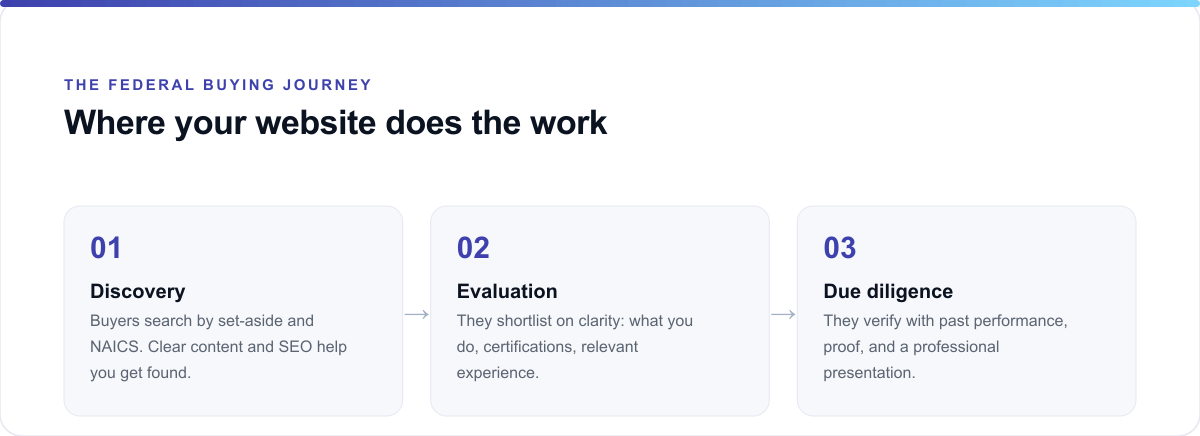
Federal procurement is methodical. A typical journey looks like this: a buyer or prime identifies a need, searches for qualified vendors (often by set-aside category and NAICS code), shortlists candidates, performs due diligence, and then engages. Your website touches almost every one of those stages - it helps you get found, it helps you make the shortlist, and it carries the due-diligence load when a buyer is checking whether you are real and capable.
The mistake many contractors make is treating the website as a brochure for people who already know them. In reality, it works hardest for buyers who do not yet know you and are deciding whether to.
The website's role at each stage
Discovery
If a buyer cannot find you, nothing else matters. Clear content around your services, certifications, and the agencies you serve - backed by solid SEO foundations - helps you surface when buyers search. Increasingly, that includes being legible to AI assistants that buyers use to research vendors, which rewards clear, structured, well-marked-up content.
Evaluation and shortlisting
Once found, you need to make the shortlist. This is where clarity wins: an instantly understandable description of what you do, your certifications, and your relevant experience. A buyer should be able to confirm in seconds that you fit the opportunity.
Due diligence
Before engaging, buyers verify. They look for proof you can perform: past performance, case studies, references, and a professional presentation that signals a low-risk vendor. This is the stage where a weak site quietly disqualifies you.
The trust signals that matter most
- Certifications, prominently displayed: 8(a), WOSB, EDWOSB, SDVOSB, HUBZone, and small-business status - visible, not buried.
- Past performance: concrete projects with client type, scope, and outcome.
- Company data: UEI, CAGE code, and relevant NAICS codes that let a buyer verify and categorise you.
- Professional design: a modern, fast, error-free site that itself signals operational competence.
- A capability statement: easy to find and download, matching your site's branding and message. (See our capability statement design guide.)
Each of these reduces the perceived risk of working with you - and risk reduction is the lever that moves federal decisions.
Technical requirements you cannot skip
Federal buyers and the systems they use have expectations. Your site should be fast, fully mobile responsive, and secure (HTTPS, sensible security headers). Accessibility matters in the government market more than most - designing toward common accessibility standards is both the right thing and a credibility signal. And the search-and-AI-readiness layer - schema markup, clean metadata, an XML sitemap, and well-structured content - is what makes your carefully written content actually discoverable. Our SEO foundation services cover exactly this layer.
Structuring the site itself
A federal contractor site does not need to be large; it needs to be clear. A proven structure is: a homepage that establishes who you are and what you are certified to do; a services or capabilities page in buyer language; a past-performance page; an about page that conveys stability and leadership; and a frictionless contact path on every page. Predictable structure helps both human buyers and the search systems that index you.
A short case in point
Consider two SBA-certified firms with identical qualifications. One has a dated site with certifications hidden on an about page, no visible past performance, and no capability statement. The other leads with its certifications, shows three relevant project outcomes, offers a clean downloadable capability statement, and loads instantly on mobile. When a contracting officer researches both, the second firm makes the shortlist and the first does not - not because it is more qualified, but because it presented as the lower-risk choice. The website made the difference.
Common federal contractor website mistakes
Even capable firms undermine themselves with predictable errors. The most common is hiding certifications on an about page instead of leading with them. Close behind is the missing past-performance section - the single most persuasive content a federal site can have, left off because it feels like bragging. Others include a capability statement that is hard to find or download, contact forms that route nowhere or go unanswered, marketing copy so generic it could describe any vendor, and a site that has not been touched in two years. Each of these is easy to fix once you see it, and each one quietly costs opportunities until you do.
Content that supports a long sales cycle
Federal decisions are slow, and a single visit rarely closes anything. That is the case for content beyond your core pages - a blog or resource section that demonstrates expertise and keeps you visible over the months a buyer takes to decide. Articles that answer the real questions buyers and partners ask establish you as a knowledgeable, low-risk vendor and give search engines and AI assistants more reason to surface you. It is the same reason you are reading this: useful content builds trust before any conversation happens. A handful of genuinely helpful articles, updated over time, compounds in value far beyond their cost.
Measuring whether your site is working
A website you cannot measure is a website you cannot improve. At minimum, set up analytics and Search Console so you can see how people find you, which pages they visit, and where they leave. Track the things that actually matter for your business: capability statement downloads, contact form submissions, and inquiries that mention the site. Over time, these numbers tell you what is working and what to fix - which pages convert, which search terms bring qualified visitors, and whether a change you made helped or hurt. Measurement turns your website from a static brochure into an asset that gets better every quarter.
Your website as a business-development asset
The contractors who get the most from their websites stop thinking of them as a one-time expense and start treating them as part of the business-development function. The site works around the clock - getting found, building credibility, capturing leads, and supporting the long evaluation process - whether or not anyone on your team is in the room. Built around the buyer and maintained with a little discipline, it becomes one of the highest-leverage investments a small federal contractor can make.
Build for the buyer, win the work
A federal contractor website succeeds when it is designed around the buyer's journey and the signals that reduce their risk - not around what you find impressive about your own company. Get the trust signals, structure, and technical foundations right, and your site becomes a quiet, tireless part of your business-development team.
Webteqno specialises in federal contractor website design and websites for SBA-certified businesses. If you want a site built to win federal work, get in touch for a free audit and a clear, scoped plan.

