
In federal contracting, the capability statement is the single most important marketing document you own. It is the one-page summary a contracting officer or prime contractor asks for when they want to know, quickly, whether you are worth a conversation. Get it right and it opens doors. Get it wrong - cluttered, generic, or hard to scan - and it gets deleted within seconds.
This guide covers what a capability statement is, why it matters, the sections it must contain, and the design choices that make buyers actually read it. If you would rather hand the whole thing off, we offer dedicated capability statement design as part of our work with federal contractors.
What is a capability statement?
A capability statement is a concise, one-page (occasionally two-page) document that summarises what your business does, what makes it qualified, and how to do business with it. Think of it as a federal-market resume for your company. It is shared by email, handed out at matchmaking events, and attached to outreach. Unlike a brochure, it follows a recognised structure that buyers expect - which means yours is judged partly on how well it conforms to that convention.
Why a strong capability statement matters
Contracting officers review a lot of these. A statement that is clear, specific, and easy to scan signals a vendor who understands the federal market. A vague, design-heavy, or text-crammed statement signals the opposite. Because it is so often the first document a buyer sees, it sets the tone for everything that follows - including whether they bother to visit your website at all.
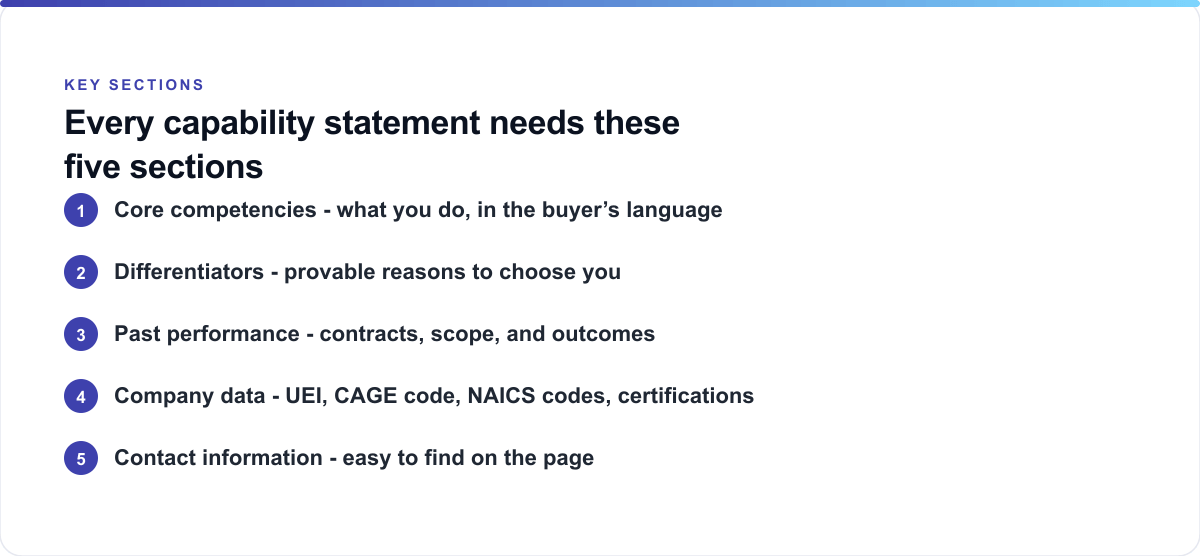
The key sections every capability statement needs
Core competencies
A short, scannable list of what you actually do - in the buyer's language, not internal jargon. Lead with the capabilities most relevant to the agencies you target. This is the section buyers read first, so make every line earn its place.
Differentiators
Why you over another vendor? Specific, provable advantages: proprietary methods, certifications, security clearances, response times, geographic reach, or measurable results. Avoid empty claims like "quality service" - they say nothing and waste the most valuable space on the page.
Past performance
The contracts and projects that prove you can deliver. List the client or agency, the scope, and the outcome. Past performance is the heart of federal credibility, so give it room.
Company data
The reference details a buyer needs to act: UEI (and CAGE code), relevant NAICS codes, certifications (8(a), WOSB, SDVOSB, HUBZone, etc.), accepted payment methods, and DUNS history if relevant. Accuracy here is non-negotiable.
Contact information
A name, direct phone, email, and website - easy to find, ideally in a consistent corner of the page. If a buyer has to hunt for how to reach you, you have failed at the one job this document has.
Design tips that make buyers read it
- Prioritise scannability. Buyers skim. Use clear headings, short lists, and white space so the key facts jump out in seconds.
- Keep it to one page. Discipline signals clarity. If everything does not fit, your content is not tight enough yet.
- Use your brand, but quietly. Consistent colours and your logo build recognition; heavy graphics and busy backgrounds get in the way of the content.
- Make certifications visible. Place certification logos or labels where a buyer scanning for a set-aside vendor will spot them immediately.
- Design for both print and screen. It should look sharp printed in black and white and read cleanly as a PDF on a phone.
Common mistakes that get a capability statement ignored
The most frequent failures are predictable: cramming three pages of text onto one page until it is unreadable; using generic claims with no proof; omitting key company data like UEI or NAICS codes; burying contact details; and letting decorative design crowd out substance. Each of these tells a buyer you do not understand how the federal market reads these documents.
How your capability statement and website work together
Your capability statement and your website are a matched pair. The statement earns the click; the website confirms the impression. They should share the same branding, the same certifications, and the same past-performance story so a buyer moving from one to the other sees a consistent, credible business. A polished statement that links to a weak website - or a strong website with a sloppy statement - sends a mixed signal that undermines both.
Tailoring your statement to each opportunity
One generic capability statement sent to every buyer is a missed opportunity. The strongest contractors maintain a core statement and then tailor it - reordering core competencies, swapping in the most relevant past performance, and adjusting language to match the agency and the specific requirement. A buyer at the Department of Veterans Affairs cares about different proof points than one at the Department of Energy. You do not need a wholly new document each time; you need a flexible master that can be sharpened for the opportunity in front of you in a few minutes. That small effort signals that you understand their mission, not just your own services.
Digital and print: formats that work everywhere
Your capability statement lives in two worlds. It is emailed and viewed on screens, and it is printed and handed out at matchmaking events. A well-designed statement works in both: it reads cleanly as a PDF on a phone, prints sharply in black and white when a buyer has no colour printer, and stays under a sensible file size so it never bounces from an inbox. Save it with a clear, professional filename - "YourCompany-Capability-Statement.pdf", not "final_v7_USE_THIS.pdf" - because that filename is part of the impression too.
How often to update it
A capability statement decays quietly. Certifications lapse, your UEI or contact details change, and your best past performance is often the contract you just finished. Treat the statement as a living document: review it whenever a certification renews, after every significant contract, and at least twice a year regardless. An outdated statement - listing an expired certification or stale contact details - does active damage, because it suggests the same inattention might show up in your contract performance.
From statement to conversation
The job of a capability statement is not to win the contract; it is to win the next step. It should make a buyer think "this firm is worth a conversation" and give them a frictionless way to start one. That means the contact details and website are easy to find, the website backs up everything the statement claims, and your response to any inquiry is fast and professional. The statement opens the door; what you do next decides whether you walk through it.
Get it done right
A capability statement is small, but it carries a disproportionate amount of weight in whether you win the next conversation. If yours is overdue for an upgrade - or you are entering the federal market for the first time - Webteqno designs capability statements alongside federal contractor websites so the two reinforce each other. Contact us to get started, and explore more of our thinking on the blog.


