
When a contracting officer or prime contractor is evaluating a small business for a federal opportunity, one of the first things they do is type your company name into Google. Long before a capability statement is read or a call is scheduled, your website is doing the talking. For SBA-certified businesses, that first impression carries unusual weight: it has to communicate credibility, capability, and compliance all at once.
Good SBA business website design is not about looking pretty. It is about answering, fast, the specific questions a procurement officer has when they land on your site. This guide breaks down the six elements that matter most and shows you how to structure each one.
Why your website matters in federal procurement
Federal buyers are risk-averse by design. Awarding a contract to a vendor who cannot perform is a career-damaging mistake, so officers look for signals that reduce that risk. A dated, vague, or hard-to-navigate website is itself a risk signal. A clear, modern, well-organised site tells the buyer you run an organised business - and that you will probably run their contract the same way.
This is the quiet due-diligence step most small businesses overlook. You do not get a meeting to explain your website; the website has to win the meeting on its own.
1. Credibility signals above the fold
The moment your homepage loads, a procurement officer should be able to tell what you do, who you serve, and that you are a legitimate, established business. That means your certifications - 8(a), WOSB, EDWOSB, SDVOSB, HUBZone, or your small-business status - belong near the top, not buried on an about page.
Pair certifications with concrete proof: years in business, number of contracts delivered, key agencies or primes served, and relevant NAICS codes. Specifics build trust. "We are a trusted partner" means nothing; "8(a)-certified, 9 years delivering IT services to civilian agencies, CMMI Level 3" means a great deal.
2. Speed and technical performance
A slow website signals a business that does not sweat the details. Officers often browse on government networks or mobile devices, and a page that takes five seconds to load erodes confidence before they read a word. Aim for a load time under two seconds, compressed images, and a clean codebase. Performance is also a ranking factor, so a fast site is easier to find in the first place.
3. Mobile responsiveness
A meaningful share of first visits happen on a phone - a buyer checking you out between meetings. If your text is tiny, your buttons are unclickable, or your capability statement will not open cleanly on mobile, you have lost them. Every page should be fully responsive and just as readable on a 6-inch screen as on a desktop monitor.
4. Clear navigation and information architecture
Procurement officers are hunting for specific information: what you do, your past performance, your certifications, and how to reach you. They should never have to dig. A simple, predictable navigation - Services, Past Performance/Work, Capabilities, About, Contact - lets them find what they need in one or two clicks. Confusing navigation reads as a confusing company.
5. Proof: past performance and case studies
Past performance is the currency of federal contracting, and your website is where you showcase it. Dedicate space to case studies and project outcomes: the agency or client, the scope, the result, and any measurable impact. Even when contract details are sensitive, you can describe the type of work, the problem solved, and the outcome in general terms. Logos, testimonials, and named references all reinforce that you have done this before and can do it again.
6. Unmistakable calls to action
Once a buyer is convinced, make the next step obvious. A prominent "Request a Capability Statement" or "Contact Us" button, a working contact form, and a monitored email address should appear on every page. Federal buyers move quickly when they are ready; a buried or broken contact path costs real opportunities.
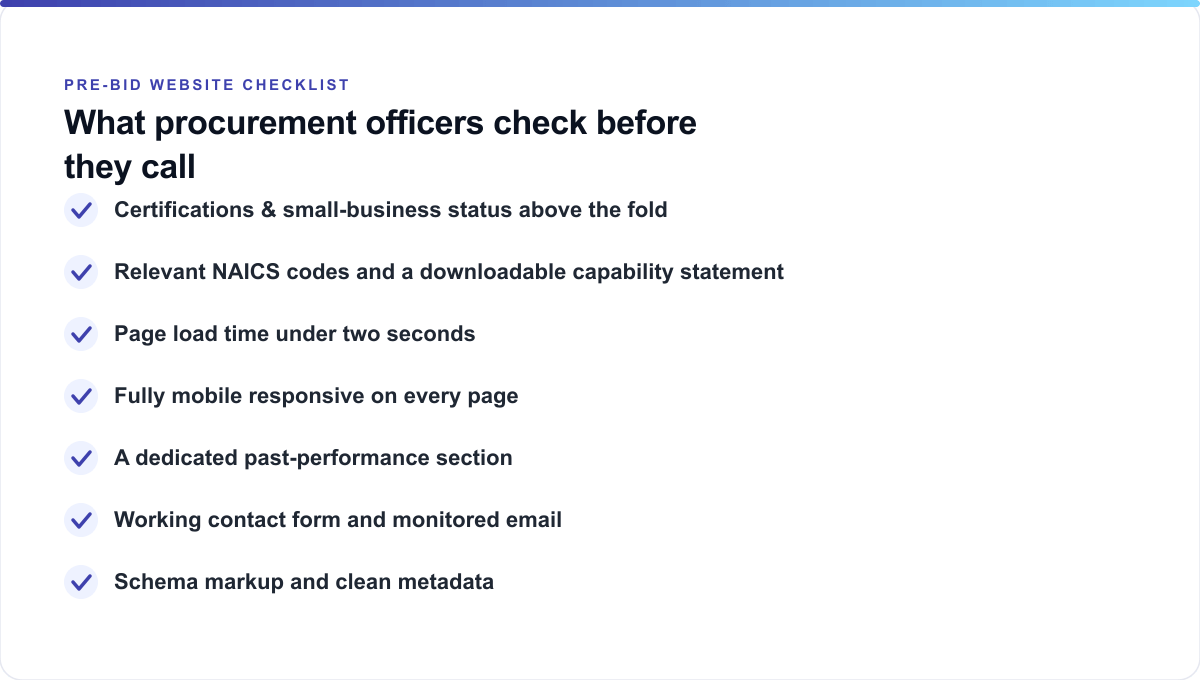
A quick pre-bid website checklist
- Certifications and small-business status visible above the fold
- Relevant NAICS codes and a downloadable capability statement
- Page load time under two seconds
- Fully mobile responsive on every page
- Clear navigation with a dedicated past-performance section
- Working contact form and monitored email
- Schema markup and clean metadata so buyers can find you in search
If you are preparing to pursue federal work, it is worth auditing your site against this list before you submit a single bid. A focused website redesign often pays for itself with the first contract it helps you win.
How AI assistants are changing vendor discovery
A growing share of early research now happens through AI assistants. A buyer or staffer asks a tool like ChatGPT, Claude, or Perplexity to "find SBA-certified IT firms with federal past performance," and the assistant summarises what it can read across the web. If your site is structured clearly, marked up with schema, and states your certifications and capabilities in plain language, you are far more likely to be surfaced and described accurately. If your key facts are locked inside images or vague marketing copy, an AI engine simply cannot represent you. Designing for this new discovery layer is the same discipline as designing for procurement officers: clarity, structure, and verifiable specifics.
Security and accessibility expectations
Government buyers are sensitive to security and accessibility in ways commercial buyers often are not. A site served over HTTPS with sensible security headers, no mixed-content warnings, and no broken certificate is table stakes - a security warning in the browser is an instant credibility killer. Accessibility matters too: designing toward common standards (sufficient colour contrast, keyboard navigation, descriptive alt text, logical heading structure) signals that you take compliance seriously, which is exactly the impression a federal buyer wants before trusting you with their requirement. These are not optional polish items; in this market they are part of the trust signal.
Turning visitors into qualified leads
Getting a procurement officer to your site is only half the job. The other half is capturing the contact before they leave. That means a contact form that asks for the right information without being a chore, a clear path to request your capability statement, and an obvious way to start a teaming conversation. Every form submission should route to a monitored inbox and get a fast human response - federal buyers move quickly when they are ready, and a 48-hour silence loses opportunities. Consider what happens after the form too: a simple confirmation, a clear expectation of when you will respond, and a follow-up process that does not let warm leads go cold.
Keeping your site current
A federal contractor website is not a set-and-forget asset. Certifications renew, past performance grows, and capabilities evolve. A site that still lists a lapsed certification or a three-year-old project quietly undermines the credibility everything else is working to build. Build a simple habit of updating past performance after each completed contract, refreshing certifications as they renew, and reviewing your core messaging once or twice a year. A current site is a credible site.
Where to go from here
Your website is the most-visited part of your federal marketing - working for you around the clock whether or not you are in the room. If it is not built to answer a procurement officer's questions, it is quietly costing you opportunities. Webteqno specialises in website design for SBA-certified businesses and federal contractors. If you would like an honest assessment of where your current site stands, get in touch for a free audit.

