
Why Most Small Business Websites Fail to Win Clients
Most small business websites are built backwards. They focus on what the business owner wants to say rather than what the potential client needs to see to feel confident hiring you. The result is a site that looks fine but generates almost no leads. The fix is almost always structural — the right small business website pages, in the right order, answering the right questions.
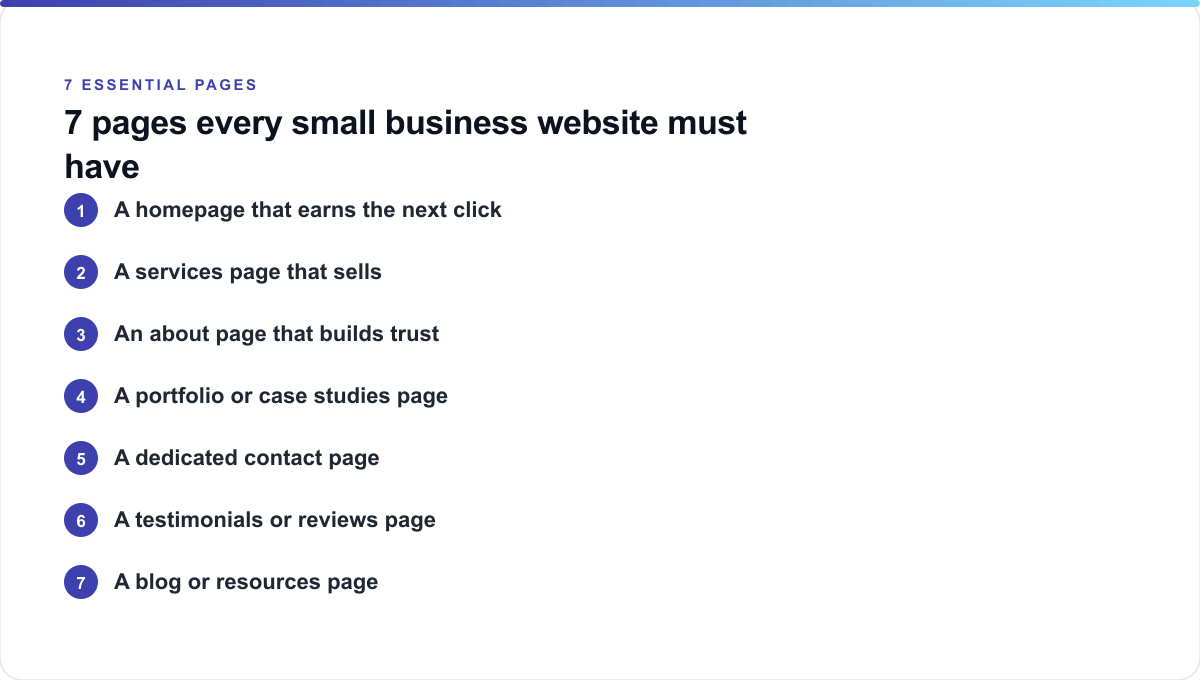
After building websites for hundreds of small businesses, federal contractors, and SBA-certified companies, we have found that the difference between a site that generates consistent inquiries and one that sits idle almost always comes down to whether these seven essential pages are present and doing their job.
Page 1: A Homepage That Earns the Next Click
Your homepage has one job: make a qualified visitor want to see more. It is not the place to explain everything about your business. It is the place to immediately communicate who you serve, what you do for them, and why you are the right choice — in that order, in under eight seconds.
Strong homepages lead with a specific value proposition, feature social proof (testimonials, client logos, or case study previews), clearly state the next action you want visitors to take, and load fast on mobile. The homepage is the most visited of all small business website pages, and most businesses underinvest in it.
Page 2: A Services Page That Sells
Your services page is where browsers become buyers. Every service you offer should have its own clear description that explains what the service includes, who it is for, and what outcome the client can expect. Vague service descriptions — "web design," "consulting," "marketing services" — kill conversion.
For businesses with multiple service lines, consider giving each major service its own dedicated page rather than listing them all on one page. This improves both clarity for visitors and search visibility for each service. One of the most important small business website pages is often the one businesses pay least attention to after launch.
Page 3: An About Page That Builds Trust
Clients hire people, not companies. Your about page is where you build the human connection that makes someone feel comfortable enough to reach out. The most effective about pages tell a specific story: why the founder started this business, who the team is, and what values guide the work.
For federal contractors and SBA-certified businesses, the about page also needs to establish institutional credibility: how long you have been in business, how many contracts or clients you have served, and what makes your organization uniquely suited to the work you do. A credible about page is one of the highest-converting small business website pages on any site.
Page 4: A Portfolio or Case Studies Page
Claims without evidence are just marketing copy. A portfolio or case studies page turns your past work into proof. For service businesses, a strong case study follows a simple structure: the client's situation before you worked together, what you did, and the measurable result afterward.
For federal contractors, this page serves as your public past performance record. Agency names, contract types, project scopes, and outcomes — presented professionally — tell procurement officers everything they need to decide whether to pursue you further. This is one of the small business website pages that directly influences whether a government buyer puts you on their shortlist.
Page 5: A Dedicated Contact Page
This sounds obvious, but a surprising number of small business websites make it genuinely difficult to get in touch. A proper contact page includes a contact form (not just an email address), a phone number, a physical address, business hours, and a realistic expectation of response time.
For businesses serving the federal market, your physical address is particularly important — it needs to match your SAM.gov registration. Making contact easy is one of the simplest improvements you can make to any small business website pages structure, and it has an immediate impact on inbound inquiries.
Page 6: A Testimonials or Reviews Page
Social proof is the most persuasive content on your website, and it is the only content you did not write yourself. A dedicated testimonials page collects your strongest client feedback in one place, making it easy for prospects to read through multiple endorsements in sequence.
Video testimonials are particularly effective. A 60-second clip of a satisfied client explaining what you did for them and what changed as a result is worth more than a dozen written blurbs. For businesses with Google reviews or Clutch profiles, embedding those on your site adds an additional layer of third-party credibility to your small business website pages.
Page 7: A Blog or Resources Page
A blog serves two distinct purposes. For SEO, it creates additional pages that can rank for search terms your potential clients are using. For credibility, it demonstrates expertise — a business that publishes useful, well-written content on its area of specialization is signaling that it knows what it is talking about.
You do not need to publish frequently. Two to four high-quality posts per month, consistently published, will do more for your search visibility and credibility than ten rushed posts. Among all small business website pages, the blog is the one with the highest long-term ROI — every post you publish continues working for years.
Bonus: What Ties All 7 Pages Together
The seven pages above only work if they share a coherent visual identity, consistent messaging, and clear navigation that makes it easy to move between them. A visitor who lands on your case studies page should be one click away from your services page, and one click away from your contact page. Every page on your site should answer the visitor's most pressing question and then make it obvious what to do next.
The technical foundation matters too. Fast page loads, mobile-responsive design, proper meta tags, and Google Analytics set up correctly are table stakes for any professional website. Your small business website pages need to work as hard technically as they do visually and editorially.
Is Your Website Missing Any of These Pages?
Run through the list above against your current site. If any of these seven pages is missing, underdeveloped, or not doing its job, that is where your next client is getting lost. A focused website improvement project does not have to mean rebuilding everything — sometimes adding or strengthening one or two of these small business website pages is enough to meaningfully increase your inbound leads.
Ready to build a website that wins clients? Contact Webteqno today for a free consultation.
Not sure who should build those pages — a freelancer, an agency, or you? We compare them in freelancer, agency, or DIY?
Think your social pages might be enough? See do I really need a website if I have Facebook and Instagram?