
"How much does a website cost?" is a fair question with a frustrating answer: it depends. But "it depends" is not an excuse to keep you in the dark. The truth is that website pricing follows recognisable patterns, and once you understand what drives the number, you can budget with confidence and avoid both overpaying and the false economy of going too cheap.
This guide breaks down realistic 2026 price ranges for a small business website, explains what actually moves the cost, weighs DIY against hiring an agency, and shows how to think about return rather than just expense.
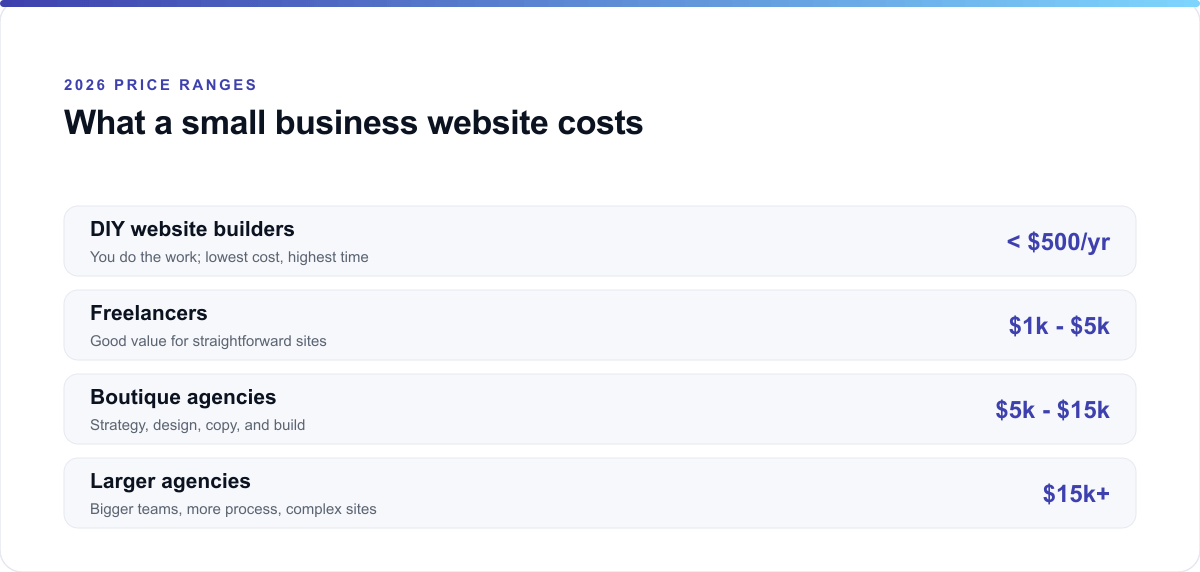
Realistic price ranges in 2026
Small business websites generally fall into a few tiers:
- DIY builders (under $500/year): Template platforms where you do the work. Lowest upfront cost, highest cost in your time and limitations.
- Freelancers ($1,000-$5,000): A single designer or developer. Good value for straightforward sites; quality and reliability vary widely.
- Boutique agencies ($5,000-$15,000): A team handling strategy, design, copy, and build. The typical home for a credible, conversion-focused small business or contractor site.
- Larger agencies ($15,000+): Bigger teams, more process, suited to complex sites or larger organisations.
Most small businesses that need a professional, lead-generating site - not just an online business card - land in the freelancer-to-boutique range. The right number depends entirely on what you are actually building.
What actually drives the cost
Number of pages and content depth
A five-page site costs less than a twenty-page site with multiple service pages and a resource library. Scope is the single biggest lever.
Custom design vs template
A bespoke design tailored to your brand and buyers costs more than a lightly customised template - and usually performs better and looks more credible, which matters in markets where trust drives the decision.
Copywriting
Words are not free. If you supply polished copy, you save; if you need the words written and structured for conversion, that is real work that affects the price.
Functionality
A brochure site is one thing; e-commerce, booking systems, gated downloads, or custom integrations add development time and cost.
SEO and technical foundations
Schema markup, fast load times, analytics, and search-readiness are part of a serious build. Skipping them lowers the invoice but undercuts the entire point of having a site people can find. These SEO foundations are an investment, not a line item to cut.
DIY vs hiring an agency
DIY platforms are tempting because the sticker price is low. They make sense if your needs are simple, your time is genuinely free, and the site does not need to win serious business. The hidden costs are your hours, a generic result that looks like everyone else's, and the opportunity cost of leads a stronger site would have captured.
Hiring a professional costs more upfront but buys strategy, a credible custom design, conversion-focused copy, and a site built to be found and to perform. For any business where the website is expected to generate leads, win contracts, or establish credibility with cautious buyers, that investment typically pays for itself. If your current site is the problem, a focused website redesign can be more cost-effective than a full rebuild.
Do not forget ongoing costs
The build is not the whole picture. Budget for domain registration, hosting, occasional maintenance and updates, and - if growth matters - ongoing SEO or content. These are usually modest next to the build, but planning for them prevents nasty surprises and a site that quietly decays.
How to think about ROI
The real question is not "what does a website cost?" but "what is a website worth to my business?" If one new client is worth several thousand dollars, a site that brings in even a handful of additional leads a year has paid for itself many times over. Frame the spend against the value of the work it can win, not against the cheapest option available. The cheapest site is rarely the most economical one.
Red flags when comparing quotes
When you collect quotes, the lowest number is not automatically the best deal, and the highest is not automatically the safest. Watch for a few warning signs. Be wary of quotes with no written scope - a price with no defined deliverables is an invitation to disputes and surprise charges later. Be cautious of anyone who will not show you previous work, who promises top Google rankings (no one can guarantee that), or who quotes a suspiciously round number without asking what you actually need. And read what is excluded: a low headline price that bills separately for copywriting, SEO, revisions, and launch can end up costing more than a higher all-inclusive quote.
Payment structures and what to expect
Most professional web projects use a milestone-based payment structure: a deposit to begin, one or more payments tied to progress, and a final payment at launch. This protects both sides and keeps the project moving. Be cautious of anyone demanding full payment upfront, and equally cautious of "no payment until you are 100% happy" arrangements that often hide vague scope and endless revision cycles. A clear, written agreement - scope, price, timeline, payment schedule, and what counts as a revision - is the sign of a professional you can trust with something this important.
Questions to ask before you hire anyone
- Can I see examples of sites you have built for businesses like mine?
- What exactly is included in this price, and what would cost extra?
- Who writes the copy - you, me, or a collaboration?
- Are SEO foundations, analytics, and mobile responsiveness included?
- What is the timeline, and what do you need from me to hit it?
- Who owns the site and the domain when we are done?
- What happens after launch - support, maintenance, updates?
The answers tell you as much about how someone works as about what they charge. A professional welcomes these questions; anyone who dodges them is telling you something useful.
Cheap, fast, good - and why scope is the real answer
The old saying is that you can have it cheap, fast, or good - pick two. There is truth in it, but the more useful framing for a small business is this: decide what the website actually needs to do, then build exactly that. A simple credibility site for a one-person consultancy genuinely can be inexpensive. A lead-generating site for a contractor competing for serious work is a different investment with a different return. The waste comes from paying for capability you do not need, or - more commonly - from underspending on a site that was supposed to win business and cannot.
Getting an accurate number for your project
The only way to know what your specific site will cost is to scope it. At Webteqno we price on scope rather than generic packages: send us a brief and you will get a written scope and a flat price within one business day - no hourly billing, no pressure. Explore our services to see what is involved, or request a quote to get a real number for your project.
Confused by the wildly different prices people quote online? We sort it out in how much should I actually pay for a website — Reddit vs reality.
Curious how WordPress fits into these numbers? Read is WordPress still good for small businesses?