
"How long will it take?" is one of the first questions federal contractors ask about a website redesign - and for good reason. A bid deadline is looming, a teaming partner asked for your capabilities, or your current site is actively embarrassing you in front of buyers. The good news: a focused, high-quality redesign for a contractor website can realistically be completed in two to three weeks.
The catch is that "two to three weeks" only works with a disciplined process and a responsive client. Below is the actual day-by-day breakdown we follow, what we handle, and what you need to provide to keep things on schedule. If you want the underlying philosophy, our process page walks through how we approach every build.
What makes a fast redesign possible
Most website projects do not take three months because the work is hard; they take three months because of slow decisions, vague feedback, and missing content. A fast redesign compresses the timeline by front-loading clarity: a tight brief, a fixed page structure, and content gathered up front. When everyone knows what is being built and why, the build itself moves quickly.
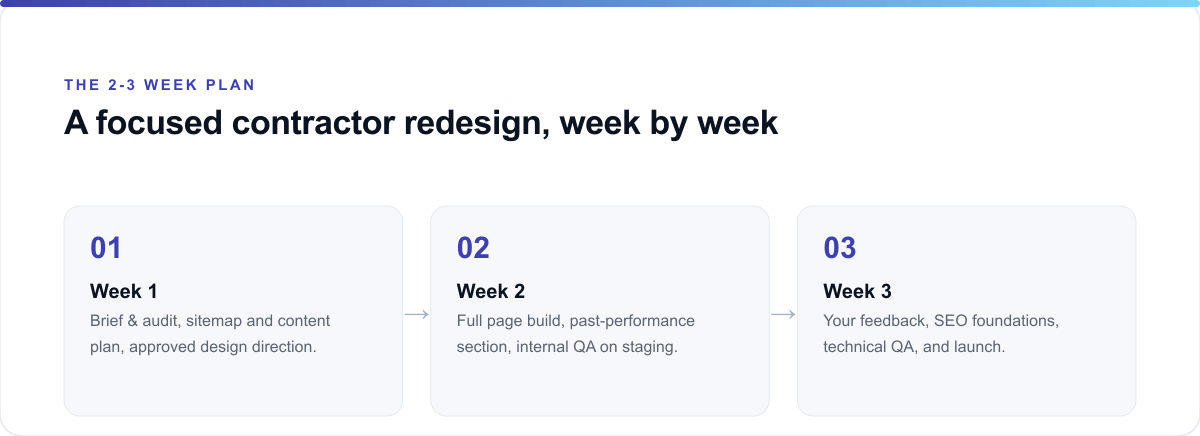
Week 1: Discovery, structure, and design direction
Days 1-2: Brief and audit
We start by reviewing your goals, your audience (agencies, primes, or both), your certifications, and your existing site. We identify what is costing you credibility or leads and agree on the pages you actually need. You provide your certifications, NAICS codes, capability statement, and any past-performance details.
Days 3-4: Sitemap and content plan
We lock the page structure - typically Home, Services/Capabilities, Past Performance, About, and Contact - and map the message hierarchy for each page. This is where we decide what a procurement officer sees first. Clear structure now prevents expensive changes later.
Day 5: Design direction
You see the homepage design direction: layout, typography, colour, and the trust-signal treatment for your certifications. We refine it with one focused round of feedback so the look is settled before full build begins.
Week 2: Build and content
Days 6-9: Page build
With direction approved, we build out every page: responsive layouts, conversion-focused copy, your past-performance section, and a downloadable or well-presented capability statement. This is the heaviest production phase, and it moves fast because the structure and design are already decided.
Day 10: Internal review
We assemble the full site on a staging URL and run our own QA - checking links, forms, mobile layout, and copy. You get a complete, clickable preview to review as a whole rather than in fragments.
Week 3: Refine, optimise, and launch
Days 11-12: Your feedback round
You review the staged site and send consolidated feedback. Because the structure was agreed in week one, this round is about refinement - wording, emphasis, a swapped image - not redesign. Consolidated, specific feedback is the single biggest factor in hitting the deadline.
Days 13-14: SEO foundations and technical QA
We wire in the technical layer: page titles, meta descriptions, schema markup, an XML sitemap, analytics, Search Console readiness, and a final pass on page speed and accessibility. This is the work that helps buyers actually find you - the same SEO foundation services we build into every site.
Day 15: Launch
We deploy to your domain, set up redirects from old URLs so you keep your search equity, verify everything in production, and confirm forms deliver to a monitored inbox. Your new site is live, fast, and ready to support a bid.
What you need to provide to hit the deadline
- A clear brief and a single decision-maker for approvals
- Certifications, NAICS codes, and capability statement up front
- Past-performance details or case-study material in week one
- Consolidated feedback within 1-2 business days at each review
- Logo and any brand assets, or a green light for us to handle branding
When a contractor comes to the table with content ready and decisions made quickly, two to three weeks is comfortable. When content trickles in and feedback arrives piecemeal, any timeline slips - which is the real reason most redesigns drag on.
What we do not compromise to hit the deadline
A fast timeline should never mean a cheap result. The speed comes from process discipline - tight scope, decisions made early, content ready up front - not from cutting corners on the things that matter. We do not skip the SEO foundations, we do not ship a site that fails on mobile, and we do not hand over something we have not tested. If a project genuinely needs more time to be done well, we say so before we start rather than rushing to a date and delivering something that embarrasses you in front of a buyer. A deadline is a constraint to design around, not an excuse for a weaker website.
Migrating content without losing search equity
If you already rank for anything, a careless redesign can wipe out that visibility overnight. The protection is methodical migration: we map every existing URL to its new destination, set up 301 redirects so old links and search results still land somewhere useful, preserve and improve your metadata, and keep your XML sitemap and Search Console current through the switch. Done properly, a redesign is an opportunity to improve rankings, not a risk to them. Done carelessly, it is one of the fastest ways to lose traffic you spent years earning.
After launch: the first 30 days
Launch day is a milestone, not the finish line. In the first month we recommend watching a few things: that forms are delivering and getting answered, that Search Console is indexing the new pages without crawl errors, that analytics is tracking correctly, and that the redirects are doing their job. This is also the window to catch the small things real-world traffic surfaces - a confusing label, a question buyers keep asking that the site should answer, a page that deserves more prominence. A short, deliberate post-launch period turns a good launch into a site that keeps improving.
Why speed is itself a competitive advantage
In federal contracting, timing matters. An opportunity appears, a teaming partner asks for your capabilities, a deadline is set - and the contractors who can present a credible web presence quickly have an edge over those still waiting on a months-long web project. A disciplined two-to-three-week process means your website is rarely the thing holding you back from pursuing work. That responsiveness is part of what you are buying, and it often matters more than any single design feature.
Is a 2-3 week timeline right for every project?
For a focused contractor site of five to eight pages, yes. Larger builds with many service pages, custom functionality, or extensive past-performance libraries may run four to five weeks - and we will tell you that up front rather than promising a number we cannot hit. The principle stays the same: clarity first, then fast execution.
If you have a deadline driving your redesign, the worst thing you can do is wait. Webteqno specialises in fast, credible federal contractor website design. Send us your brief and we will respond within one business day with a written scope, a flat price, and a specific launch date. Start here.

